
Since 2017, we at Air Passenger Rights have been cautioning the government that Canada's passenger rights regime is deficient. It is filled with loopholes that shield airlines from liability and make the regime unnecessarily complex and unworkable.
The regime is so complex that a decision maker must review hundreds, if not thousands, of pages of documents, consuming a full working day on average, to resolve a mere $400 case. For example, in a 2021 case against Air Canada, a Nova Scotia small claims court found that the APPR (the Air Passenger Protection Regulations) were falling short of being consumer-friendly or meeting any of the goals or objectives that a consumer protection legislation would have:
"Its language is complex and legalistic; one needs detailed or specific knowledge to invoke the claims system; and the process to seek compensation, once invoked, does not lend itself to a quick resolution."
And then the court went on to say:
"Few individuals would undertake such efforts to seek a few hundred dollars in compensation. Even if they wanted to, fewer would undertake such a claim. Close to 1000 pages of paper were exchanged in a $400 claim."
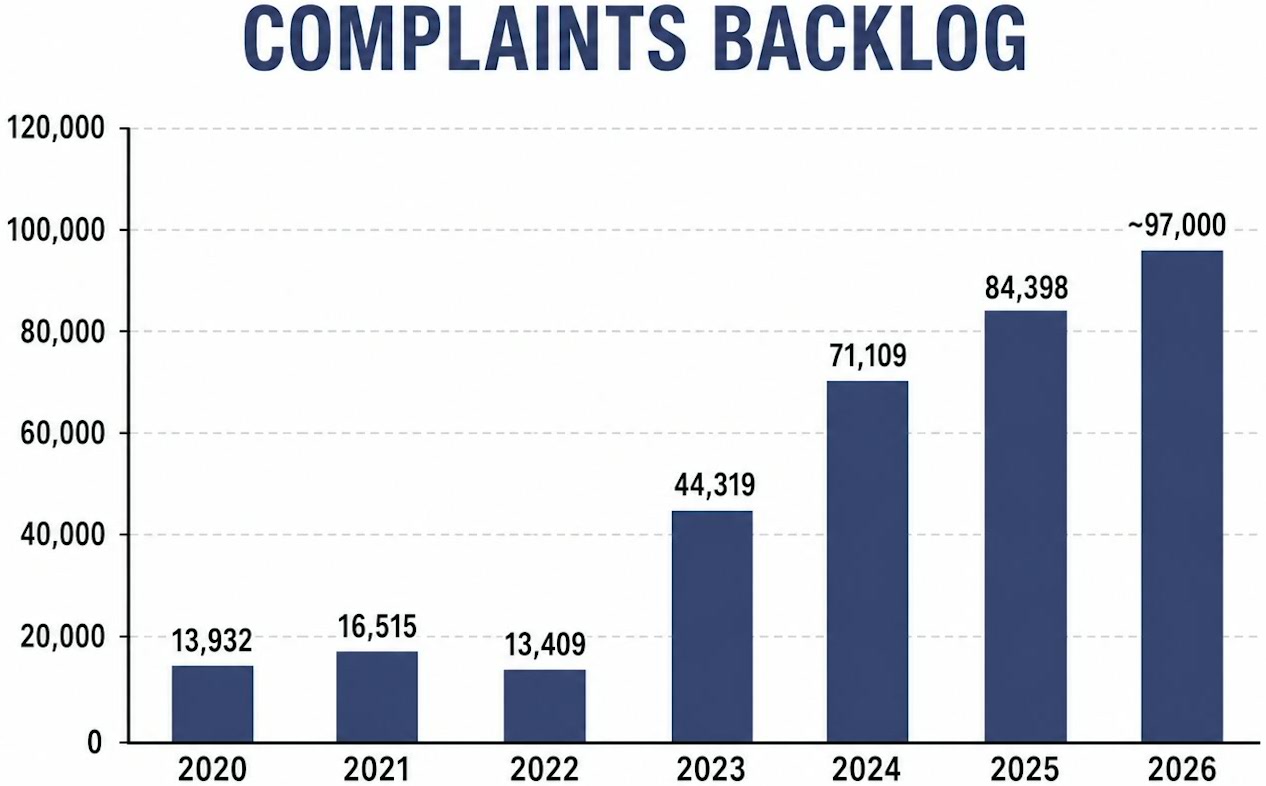
This is exactly what we have been talking about. As we predicted, the Canadian Transportation Agency has accumulated a 97,000-complaint backlog.
Why is the System Broken?
After nine years of denial, on May 1 this year (2026), the government finally admitted that the system is broken.
Two government failures are the root cause of the broken system that Canadians like you and me are facing today when we deal with passenger complaints.
First, the government's unwillingness to implement and impose significant fines on airlines that violate passengers' rights. In the few cases, when a fine is being imposed at all, the amount is laughable. It is just pocket money for the airlines and it does not have a profit-altering effect. It does not foster compliance. It is just the cost of doing business for the airline.
And second, the government's refusal to adopt the European Union's gold standard of passenger protection, where eligibility for compensation can be determined in a matter of minutes, just using publicly available data, rather than pouring through hundreds or thousands of pages of documents and lengthy adjudication
Bill C-31:How Ottawa Proposes to Fix the System
Rather than addressing these failures, the government proposes in Bill C-31 to delegate to third parties handpicked by the airlines the authority to issue legally-binding decisions in passengers' complaints.
So let's get it right.
When you have a complaint against the airline, the government proposes that the adjudicator in the complaint will be someone whom the airline handpicked.
Why the Government's Proposal is Flawed
In our view, the government's proposal is illusory, ineffective, unfair to passengers, and unprecedented in the Western world.
It is illusory and ineffective, because swapping decision makers closes no loopholes, leaves complexity intact, and does not enhance enforcement. Without fixing these root causes, any complaint system, however structured, will perpetuate, not resolve, the crisis.
The government's proposal is also unfair to passengers, because the airlines would be handpicking private entities to adjudicate complaints against themselves.
A glaring conflict of interest. No impartial decision maker can emerge where the adjudicator's livelihood depends on the airline's continued goodwill. This would create the most airline-friendly passenger protection regime in the Western world, surpassing even Canada's broken Transportation Agency.
It is unprecedented in the Western world and dissimilar to any existing alternative dispute-resolution mechanism in Canada, the European Union, or the United Kingdom.
- Regulation 261/2004 of the European Union and its United Kingdom counterpart, contain no provisions for private third party adjudication binding on passengers.
- The alternative dispute-resolution schemes that do operate and exist in Europe supplement the legislative frameworks, leaving passengers free to reject outcomes, and pursue legal action.
- Canada's own telecommunication complaints system, the CCTS, if you may be familiar with it, similarly lacks a binding authority over consumers. Their decisions are binding only on the telecommunication companies, but consumers are free to accept or reject it. If they reject it, they can then take the telecommunication company to court.
In no comparable jurisdiction have lawmakers granted private entities, selected by the industry, in this case, the airlines, the authority to impose legally-binding decisions on consumers, or passengers in this case.
Letting the Fox Guard the Henhouse
On May 1, the government admitted Canada's passenger rights system is broken. But instead of fixing it, the government is proposing to hand that broken system to the airlines themselves.
Let that sink in.
The same government that built a 97,000 complaint backlog now wants airlines to pick their own judges.
This is not a fix. This is the fox guarding the henhouse, legislated by the same government that let the hens get loose in the first place.
A Solution to This Problem Does Exist
The European Union's standard has been tested and has worked for more than 20 years now.
The government should adopt it, not delegate passenger rights to airlines and then call it a "reform."
Take Action
If you care about your passenger rights as we do, this is the time to take action.
- Pick up the phone, call your federal Member of Parliament, and tell them that you don't accept that your rights be determined by someone who was handpicked by the airline.
- Ask for an in-person meeting with your federal Member of Parliament.
- Insist on speaking to them on the phone, if they cannot meet you in person.
This is the time to speak up. If you remain silent, later it may be too late.
Act now!
Together we can bring Canada real, meaningful, European-style passenger rights.
Thank you.
